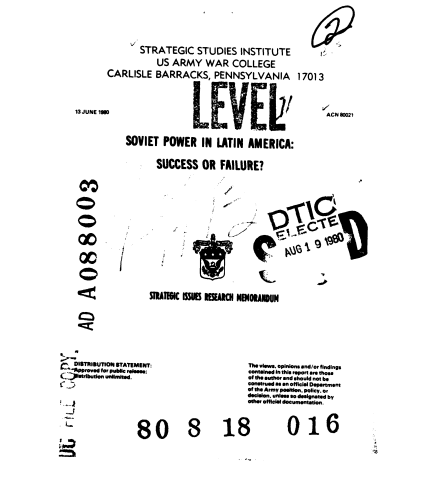
Strategic Studies Institute memorandum written by political scientist W. Raymond Duncan in 1980 examines the true extent of Soviet influence in Latin America during the late Cold War. Produced through the U.S. Army War College, the paper evaluates Soviet political, economic, diplomatic, and ideological strategies throughout Latin America and the Caribbean following events such as the Cuban Revolution, the rise of the Sandinistas in Nicaragua, and growing Soviet-Cuban cooperation in the region, which led to a direct rise in anti-imperialist nationalism and support for Communist parties. Improved Soviet influence and relations reached as far north as Mexcico.
This source is interesting because rather than arguing that the USSR fully controlled revolutionary movements in the region, Duncan emphasizes that Soviet policy was often pragmatic, limited, and shaped heavily by Latin American nationalism and anti-imperialism, most of which was targetted against the US. As the Soviets marketed themselves as a way to fight the US imperialism that many people saw was an existential threat to their communities, the Soviets found great success in Latin American intervention. One particularly interesting section also discusses how China increasingly challenged Soviet influence in Latin America during the 1970s through trade, diplomacy, and anti-Soviet rhetoric, demonstrating that Latin America had become a broader arena for global communist competition rather than solely a Soviet-American battleground. However, more importantly, this article shows that the Chinese are veterans of intervention of Latin America and have been using tactics shown to work for the Soviet Union in their own way, something they are still doing but now against the US.
Source:
Duncan, W. Raymond. 1980. Soviet Power in Latin America: Success or Failure? Carlisle Barracks, PA: Strategic Studies Institute, U.S. Army War College.