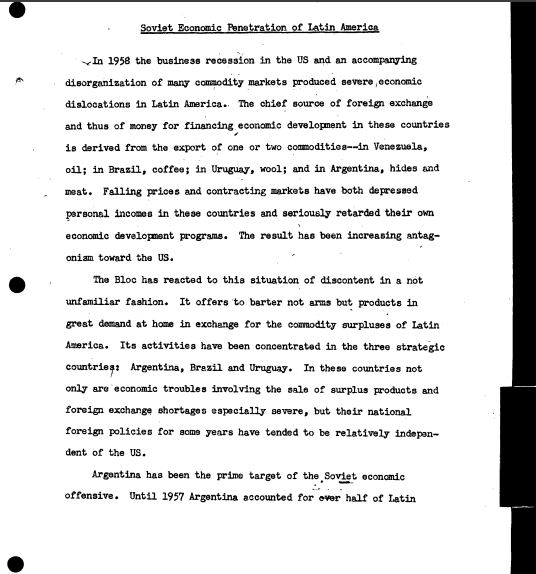
This CIA report from 1958 examines the economic conditions in Latin America and explains why the Soviet Union became increasingly interested in expanding its influence throughout the region during the early Cold War., The report focuses heavily on how the USSR attempted to exploit economic instability, anti-American sentiment, and resource shortages in Latin America that was created due to the 1958 American recession. By doing this, the USSR wanted to build stronger political and economic relationships by capitalizing off the fall of the US during their recession that extended into non-American countries that had major trade with the US. The document specifically discusses Soviet trade agreements, oil exports, and industrial assistance designed to increase Soviet influence while simultaneously weakening American economic dominance in the Western Hemisphere. Countries such as Argentina, Brazil, and Uruguay are repeatedly highlighted as major targets of Soviet economic expansion because of their economic importance, natural resources, and dependence on foreign imports like fuel and lubricants as they could be easy targets for the USSR to go after.
This source shows how Soviet influence in Latin America relied heavily on economic diplomacy and long-term dependency rather than military aid alone. Not only did economic diplomacy increase the trust and understanding between the two nations, it helped the USSR grandstand on the national stage as it allowed the Soviets to frame their support as genuine humanitarian assistance but in reality have their aid as more as a strategic attempt to expand global Marxist-Leninist influence during the Cold War. The exploitation of economic hardship and instability in Latin America became a continual trend for Soviet leadership, with the USSR being able to frame itself as the alternative partner to not just the US but also capitalism.
Source:
CIA. 1958. Soviet Economic Penetration of Latin America. Central Intelligence Agency.